
A Critical Examination of the Roman Catholic Definitions of Dulia and Latria
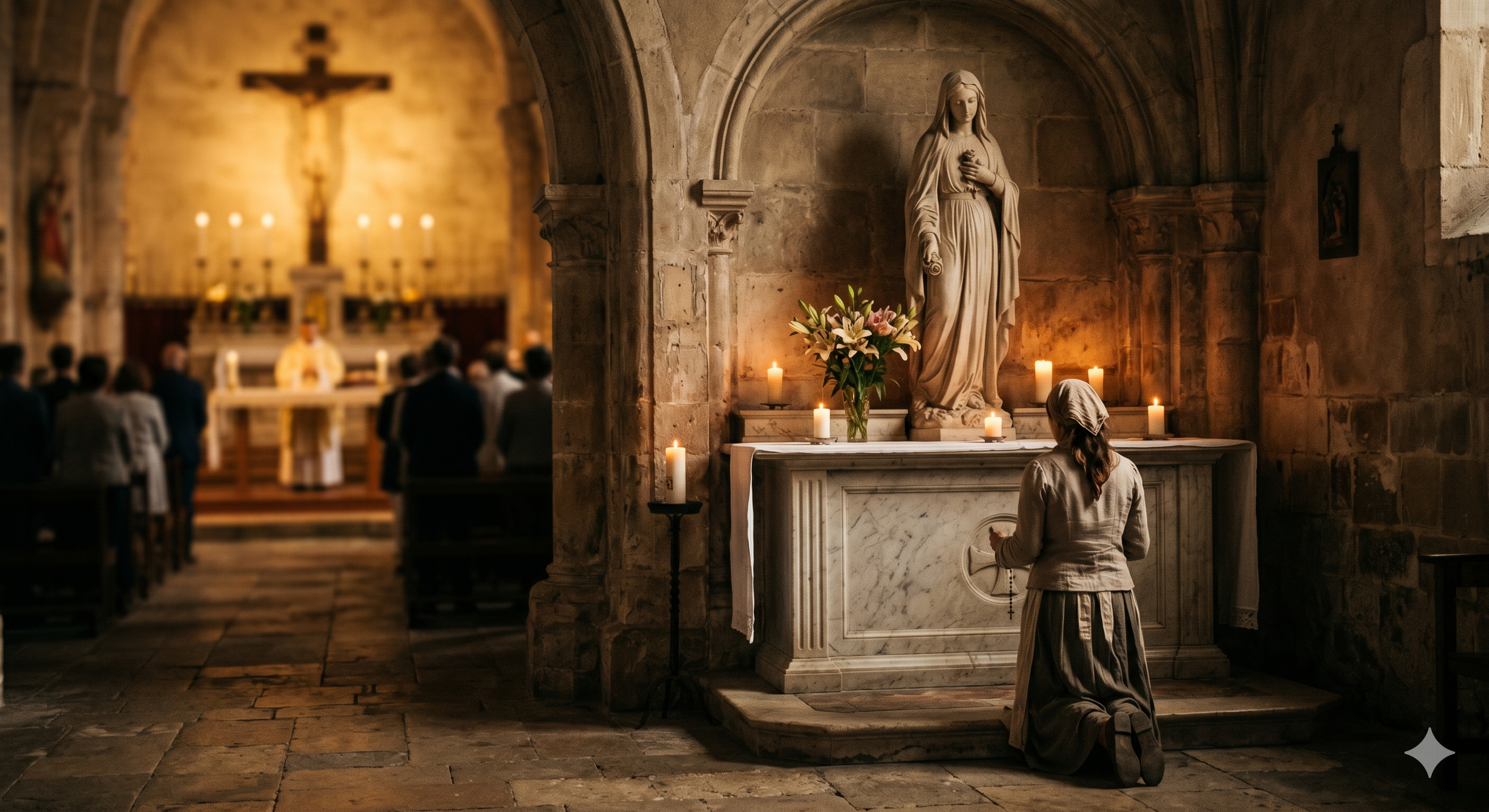
Introduction: How to Offend a Roman Catholic 101
“You guys worship the Virgin Mary and the saints, that’s idolatry!”
This phrase (and phrases like it) make me cringe every time I hear them. When evangelicals talk with Roman Catholics about faith, we frequently get stuck on Mary and the saints. Take, for example, a recent discussion on the Pints with Aquinas podcast between Matt Fradd and Jarret LeMaster.[1] While both Roman Catholic Fradd and protestant LeMaster were respectful and honest about their differing views, there were a few awkward moments where there was clear ignorance about Mary and the saints. Remarkably, when at one point they were discussing prayer to the saints and to Mary, Fradd contended that a “Catholic might mean prayer in the Old English sense”.[2] The differences we have in definitions for words like “prayer” is revealing: we have Same words, different worlds.[3]
Getting lost in words is a lot more than being caught up in semantics. This is especially the case with the question of devotion to Mary and the saints. Roman Catholics have three distinct words to distinguish the values of three different practices: dulia (veneration), hyperdulia (hyperveneration), and latria (worship). In this way worship is reserved for the Trinity alone, hyperveneration for Mary, and veneration for the saints. These definitions are to serve as a safeguard from idolatry.
Enter the awkward protestant. “You guys worship Mary!” Not much could be more offensive to a Roman Catholic. The problem is that we, as evangelicals or protestants do not know or see the difference between veneration (& hyperveneration) and worship. But is there a difference? This article will be a critical examination of the Roman Catholic definitions of dulia[4] and latria. We will look at definitions from a historical, theological, linguistic and biblical perspective to examine the distinction between latria and dulia and offer a critique from an evangelical perspective. There is a lot to say on Mariology and the cult of the Saints, but for this article I will specifically assess the terminology.
How did they get there?
Documents from the Second Vatican Council and the 1994 Catechism of the Catholic Church have been readily available in multiple languages, making them a helpful place to start looking at definitions. In addition, these documents cite early documents, which will be looked at next. So, working backwards from Vatican II and the Catechism, this section will conduct an examination of the terminology.
Sacrosanctum Concilium
Sacrosanctum Concilium V, section 111 says in the original Latin: “Sancti iuxta traditionem in Ecclesia coluntur, eorumque reliquiae authenticae atque imagines in veneratione habentur.”[5] (Emphasis added) This is translated into other languages as:
English: The saints have been traditionally honoured in the Church and their authentic relics and images held in veneration.
French: Selon la tradition, les saints sont l’objet d’un culte dans l’Église, et l’on y vénère leurs reliques authentiques et leurs images.
Spanish: De acuerdo con la tradición, la Iglesia rinde culto a los santos y venera sus imágenes y sus reliquias auténticas.
Italian: La Chiesa, secondo la sua tradizione, venera i santi e tiene in onore le loro reliquie autentiche e le loro immagini.
Portuguese: A Igreja, segundo a tradição, venera os Santos e as suas relíquias autênticas, bem como as suas imagens.
What is striking in these translations is the variety of translations. One would not expect to see vastly different translations between Latin-based languages, and yet there is. The sentence in Latin has two key terms: coluntur and veneratione. The first word, coluntur, from the Latin colo, means to cultivate, to care for, or to regard with care (worship, honour, reverence).[6] It is where English gets words like cultivate, agriculture and cult. It is also revealing to look at the use of the word colo in the Vulgate. In Genesis 2:15 it is used as God’s instruction to cultivate the earth, but in Exodus 23:25 and Romans 1:25 to mean worship. It does have a notion of reverence, and it has its agricultural origins in cultivation. But when it is used in the religious sense in the Vulgate it is a to reference worship or to honouring God’s commandments. In the above translation of Sacrosanctum Concilium, it is translated in English as honoured, in French and Spanish as cult/worship,[7] and in as Italian and Portuguese: venerate. There is a vast spectrum of meaning behind these words.
The second Latin word is veneratione and one would expect the word to be almost directly translated. French, English Spanish and Portuguese do just that, using a form of the word “veneration.” The Italian translation, having already used the word venerate to translate coluntur, uses onore or honour. Finally, the Portuguese chooses no distinction between the words coluntur and veneratione, referring equally to both acts as veneration.
The Latin description of this section in the Sacrosanctum Concilium talks about “coluntur/worship/reverence” for the saints and veneration for relics and images. Looking at the different translations however, the terminology varies enough to suggest that the term is either unclear, or its direct translation is so susceptible to misunderstanding that translators have need to interpret it from the Latin, rather than translate directly. For further definition, the next document to look at is the Catechism, which outlines the current teachings of the Roman Catholic Church.
Catechism
The Catechism of the Catholic Church, published in 1994 during the pontificate of John Paul II is one of the most useful sources for understanding the present-day teaching of the Roman Catholic Church. It is structured in four sections, each based on a key pillar of the Roman Catholic faith: 1) The Apostles’ Creed, 2) The Seven Sacraments, 3) The Ten Commandments and 4) The Lord’s Prayer. The discussion about veneration and hyperveneration can be found in the part 3, which is structured around the Ten Commandments, in the section entitled “you shall not make a graven image”.[8] The key texts are cited in full below:
IV. "You Shall Not Make For Yourself a Graven Image . . ."
2129 The divine injunction included the prohibition of every representation of God by the hand of man. Deuteronomy explains: "Since you saw no form on the day that the Lord spoke to you at Horeb out of the midst of the fire, beware lest you act corruptly by making a graven image for yourselves, in the form of any figure...." It is the absolutely transcendent God who revealed himself to Israel. "He is the all," but at the same time "he is greater than all his works." He is "the author of beauty."
2130 Nevertheless, already in the Old Testament, God ordained or permitted the making of images that pointed symbolically toward salvation by the incarnate Word: so it was with the bronze serpent, the ark of the covenant, and the cherubim.
2131 Basing itself on the mystery of the incarnate Word, the seventh ecumenical council at Nicaea (787) justified against the iconoclasts the veneration of icons - of Christ, but also of the Mother of God, the angels, and all the saints. By becoming incarnate, the Son of God introduced a new "economy" of images.
2132 The Christian veneration of images is not contrary to the first commandment which proscribes idols. Indeed, "the honour rendered to an image passes to its prototype," and "whoever venerates an image venerates the person portrayed in it."[9] The Honor paid to sacred images is a "respectful veneration," not the adoration due to God alone:
“Religious worship is not directed to images in themselves, considered as mere things, but under their distinctive aspect as images leading us on to God incarnate. the movement toward the image does not terminate in it as image, but tends toward that whose image it is.”[10]
This section of the Catechism is helpful and also points us to some other earlier texts which we will look at, like Nicaea II, Aquinas and Basil the Great. This section of the Catechism defends without hesitation or warning the veneration of images, using both extra-canonical and Old Testament references to rationalise the “Christian veneration of images”.[11]
The Principle of Basil the Great
To justify the practice, not only in the Catechism, but throughout church history, Basil of Caesarea is cited: "the honour rendered to an image passes to its prototype."[12] Some people may in fact honour or venerate the image itself, but the concept that a person praying in front of a statue is really praying to or venerating the person that the statue represents is logical. We might all have different views of this, but imagine for a moment that I go into a Protestant church where there is a painting portraying Jesus or the Last Supper. If while sitting in front of that image I pray to Jesus, we would likely agree that I’m not praying to the painting, but to Jesus. (I’m not condoning or condemning the practice, but demonstrating how a Catholic might defend this practice, following the principle outlined by Basil.) Of course, the example I’m giving is praying to Christ, not a saint. Basil is saying that honouring or venerating an image is an act of venerating or honouring that saint, and therefore there is no significant distinction between veneration of the image or the saint.
Nicaea II 787
The other text referenced in the Catechism and which is cited to justify the practice of veneration is from Nicaea II, which is a key source of confusion regarding saints and their images: (emphasis added)
For by so much more frequently as they are seen in artistic representation, by so much more readily are men lifted up to the memory of their prototypes, and to a longing after them; and to these should be given due salutation and honourable reverence (ἀσπασμὸν καὶ τιμητικὴν προσκύνησιν), not indeed that true worship of faith (λατρείαν) which pertains alone to the divine nature; but to these, as to the figure of the precious and life-giving Cross and to the Book of the Gospels and to the other holy objects, incense and lights may be offered according to ancient pious custom. For the honour which is paid to the image passes on to that which the image represents, and he who reveres the image reveres in it the subject represented.[13]
Again, the quotation is similar to Basil: “Whoever venerates an image, venerates the person portrayed in it.” But it is the Latin translation of this text, “qui adorat imaginem, adorat in ea depicti subsistentiam” which created some confusion following the Second Council of Nicaea. Both Greek words λατρείαν (worship or adoration) and προσκύνησις (veneration or reverence, as in the above text) are translated by the same Latin verb adorare. This scandalous Latin translation, led to the Franks to thinking that the council affirmed the worship of images as to the worship of the Trinity.[14] created such a stir that 7 years later (794) the Franks held the Synod of Frankfurt, rejecting the council altogether.
The Catholic claim remains that there is a clear distinction between latria and dulia, worship and veneration, and any confusion is because of a translation error. There is evidence of confusion and ambiguity creating issues: from Nicaea II all the way to translations of the Vatican II documents. To examine beyond linguistic distinctions, it is important to look at other key thinkers in this discussion throughout history, such as Aquinas and the Reformers, and also the biblical terminology.
Aquinas
Aquinas is most frequently cited as being the one who most clearly articulated the distinction between veneration of saints and the worship of God. While the terms latria and dulia had been used in the past, they are unpacked by Aquinas. Hyperdulia is added later. But in unpacking these terms, does Aquinas sufficiently determine a difference between the two? We will look at some key concepts in Aquinas.
Aquinas questions the gesture of adoration and the place of the body in the gesture. In questioning the physical gesture, he is evoking the “twofold nature”: intellectual and sensible.[15] Spiritual adoration is internal and intellectual. Bodily adoration is an “exterior humbling of the body”, which is “offered on account of interior adoration.”[16] In brief, Aquinas states that: “Even bodily adoration is done in spirit, insofar as it proceeds from and is directed to spiritual devotion.”[17] The external gesture is directed by the internal, intellectual and spiritual devotion.
Aquinas spends a very significant portion of articles on questions of piety, religion, dulia, devotion, adoration, etc., and yet he is still difficult to comprehend on the subject. But what he does articulate is the challenge of understanding latria and dulia. Dulia can mean servitude or honour and has a broad sense and various different aspects. But both latria and dulia have internal and external realities. The problem is that the external physical gestures of latria and dulia are identical. If you bow down to a pagan idol, it is idolatry; if you bow down before a cross, it is latria; if you bow down in prayer to the Lord, it is latria, if you bow down to an image of Christ it is latria. If you bow down to a statue of a saint or before a reliquary, it is considered dulia. Why? Aquinas seems to indicate that the bodily/sensible gesture of adoration is not the determinant, but rather the intellectual/spiritual/internal adoration that is the true definer of dulia vs. latria. Bodily actions proceed from and direct to spiritual devotion.
There is a certain logic to Aquinas’ view that we can agree with. Worship must come from the heart, and external gestures without a Godward heart are meaningless. (Isaiah 29:13) However, the consequence of Aquinas’ internal-only distinction of dulia and latria is that by focusing on intention there can be ambiguity in determining the nature of outward gestures. Roman Catholicism seems focussed on the internal intention for distinguishing between latria and dulia, but for the sacraments, the focus is the reverse: the internal intention may be flawed, but the sacrament is still efficacious in conferring grace.[18] Your heart might not be in it fully, you might not even believe it, but if you go to Mass every Sunday and partake of the Eucharist, Roman Catholicism teaches that grace is still conferred through the external act. This discussion moves away from the topic at hand, but shows that trying to separate the internal intention from the external gesture is problematic and confusing, whether it be for the sacraments or for the definitions of dulia and latria.
Aquinas dedicates many questions in his Summa to the topics of dulia, latria, honour and praise, but it is this twofold nature, internal and external, intellectual and sensible, which are most important to this present critical examination.
Biblical Terms for Worship and Veneration
Aquinas evokes an interesting aspect that in modern times we tend not to discuss: the physicality of worship. Scripture also evokes bodily vs. internal adoration, especially when we look at the terms. As we have already seen, the Greek verb for worship is προσκυνέω, which literally means to bow down. The Greek evokes a visual image of bowing down, of prostrating oneself. In Scripture it is always used for bowing down to the Lord and only in one other instance, Revelation 14:11 when people worshipped/bowed down to the beast. Worship has a physicality to it, it is a physical gesture.
Calvin’s Response to Roman Catholic Veneration
There is a lot more depth that could go into this study of dulia and hyperdulia, but this article aims to focus on the definition of the terms for veneration. Therefore, though there could be whole dissertations written about each of the different reformers’ responses to the veneration of the saints and another on the council of Trent, only some brief comment will be made.
One reason I only need to make a brief comment regarding the Reformers is that I don’t think anyone could make a clearer statement about latria and dulia from a Protestant perspective that Calvin. It speaks for itself:
The distinction of what is called δυλια and λατρια was invented for the very purpose of permitting divine honours to be paid to angels and dead men with apparent impunity. For it is plain that the worship which Papists pay to saints differs in no respect from the worship of God: for this worship is paid without distinction; only when they are pressed they have recourse to the evasion, that what belongs to God is kept unimpaired, because they leave him λατρια. But since the question relates not to the word, but the thing, how can they be allowed to sport at will with a matter of the highest moment? But not to insist on this, the utmost they will obtain by their distinction is, that they give worship to God, and service to the others. For λατρεὶα in Greek has the same meaning as worship in Latin; whereas δουλεὶα properly means service, though the words are sometimes used in Scripture indiscriminately. But granting that the distinction is invariably preserved, the thing to be inquired into is the meaning of each. Δουλεὶα unquestionably means service, and λατρεὶα worship. But no man doubts that to serve is something higher than to worship. For it were often a hard thing to serve him whom you would not refuse to reverence. It is, therefore, an unjust division to assign the greater to the saints and leave the less to God. But several of the ancient fathers observed this distinction. What if they did, when all men see that it is not only improper, but utterly frivolous? Institutes, Book I, 12, §2[19]
Calvin eloquently rejects any separation between latria and dulia, highlighting what we have seen throughout this examination: an ambiguity and an interchangeability of the terms. To strengthen his argument, he takes it one step further, suggesting that if we were to identify a difference between the two terms, the act of service (dulia) is the greater gesture and ought to be offered to God. Calvin is therefore accusing Roman Catholicism of offering gesture to saints and angels.
Conclusion
At the outset of this project, I had aimed to uncover a clear definition of the terms dulia and latria in order to offer a deep reflection on the Roman Catholic practice of veneration. What we have seen instead is the opposite: the intention seems to be to create a clear distinction where there one does not exist, in order to justify the practice of venerating saints, images and angels. For over 1300 years the terms have been used so interchangeably and are misunderstood so frequently, between modern languages and between Greek and Latin, that it is difficult to contend that the terms are vastly different, linguistically or practically. Indeed, externally, the physical gestures of dulia and latria — veneration of saints and the worship of God alone are identical.
Rather than arriving at clear definitions or distinctions, I found myself pondering a deeper question: why? Why is it so necessary to distinguish between dulia and latria? Richard Price, in his commentary and translation of Nicaea II critically offers an explanation:
The iconophiles did not think it possible that God’s faithful people as a whole could have fallen into error, and least of all into idolatry, which (in the eyes of iconophiles and iconoclasts alike) was not a mere extravagance of piety but apostasy from the Christian faith.[20]
Saints have been venerated since the early centuries of Christianity. Is it possible for so many people, including some in the Early Church and church fathers, to fall into the trap of idolatry? Can the whole church err? As protestants we can say a resounding “yes” it is possible. But thanks be to God, who does not abandon us in our error, but refines, sanctifies and saves. The distinction between latria and dulia is a means of justifying error and results in less glory for God. It upholds the Jesuit principle: Ad mairorem Dei Gloriam – to God be the greater glory. This is still declared today—I heard it 2 months ago. It was at that moment that I realised that Soli Deo Gloria is far more profound than I had realised. When I share my evangelical faith with my Catholic friends and neighbours, I do so as a worshipper and a venerator of the Living God. Why do I not venerate the saints? Soli Deo Gloria. There is no space or time for venerating anything or anyone else. If I devoted every minute of every day to worshipping God for the rest of my life, He would still be worthy of more glory.
Soli Deo Gloria. To God alone be the glory, all the dulia and all the latria.
[1] Are Catholic Teaching’s Biblical?, Pints with Aquinas, 2025.
[2] Are Catholic Teaching’s Biblical?, 2.50.
[3] Leonardo De Chirico, Same Words, Different Worlds : Do Roman Catholics and Evangelicals Believe the Same Gospel? (Nottingham: Apollos : Inter-Varsity Press, 2021).
[4] As hyperdulia is derivative of dulia, I will simply refer to dulia, though it is applicable to both.
[5] Vatican Council II, “Sacrosanctum Concilium,” in Vatican Council II : The Conciliar and Postconciliar Documents, ed. Austin Flannery, New revised edition. (Collegeville, Minnesota: Liturgical Press, 2014), §111.
[6] Charlton T. Lewis and Short Charles, “Cŏlo,” A Latin Dictionary.
[7] The word “culte” in French is also the word used for a protestant church service and is not to be confused with the notion of cultic and sectarian practices.
[8] Austin Flannery, ed., Catechism of the Catholic Church, 2nd ed., United States Conference of Catholic Bishops (Vatican City: Libreria Editrice Vaticana, 2019), §§2129–2132.
[9] Quoting Basil the Great.
[10] Thomas Aquinas, Summa Theologica, Part II-II, trans. Fathers of the English Dominican Province, Benziger Bros., 1947, http://www.gutenberg.org/ebooks/18755, Q81, 3 ad 3.
[11] Sirach (Ecclesiasticus) 43:27–28, Wisdom 13:3, Exodus 25:10–22, 1 Kings 6:23–28 & 7:23-26.
[12] St. Basil, De Spiritu Sancto 18, 45: PG 32, 149C
[13] Henry R. Percival, The Seven Ecumenical Councils of the Undivided Church: Their Canons and Dogmatic Decrees, Together with the Canons of All the Local Synods Which Have Received Ecumenical Acceptance, Kindle. (Eugene, Oregon: Wipf & Stock Publishers, 2021), 1463.
[14] Percival, The Seven Ecumenical Councils of the Undivided Church: Their Canons and Dogmatic Decrees, Together with the Canons of All the Local Synods Which Have Received Ecumenical Acceptance, 1552.
[15] John of Damascus, “An Exact Exposition of the Orthodox Faith,” in A Select Library of Nicene and Post-Nicene Fathers of the Christian Church. Second Series, ed. Philip Schaff and Henry Wace (Grand Rapids, Mich.: Eerdmans, 1983), bk.4, chap. 12 https://ccel.org/ccel/s/schaff/npnf209/cache/npnf209.pdf.
[16] Thomas Aquinas, Summa Theologica, Part II-II, trans. Fathers of the English Dominican Province, Benziger Bros., 1947, http://www.gutenberg.org/ebooks/18755, Q84.A2.C.
[17] Thomas Aquinas, Summa Theologica, Part II-II, trans. Fathers of the English Dominican Province, Benziger Bros., 1947, http://www.gutenberg.org/ebooks/18755, Q84.A1.
[18] Flannery, CCC, §§1128–1130.
[19] John Calvin, Institutes of the Christian Religion, trans. John Allen, 6th ed. (Grand Rapids, Mich.: Presbyterian Board of Publication, 1813), vol. 1, bk. 1, chap. 12, §2, http://www.ccel.org/c/calvin/institutes/institutes.html.
[20] Council of Nicaea, The Acts of the Second Council of Nicaea (787), trans. Richard Price, vol. 68 of Translated Texts for Historians (Liverpool: Liverpool University Press, 2020), 43.
