
“A knotty and useless question?” Justification 500 years on from the Reformation
In 2017, the world celebrated the 500th anniversary of Martin Luther posting his ninety-five theses, and religious leaders naturally weighed in. Perhaps the most prominent was Pope Francis I, who urged people to heed the call for Christian unity; where Luther had created disunity and broken apart the Church, the time had now come for reconciliation and togetherness. In one message at the start of the anniversary year, Francis encouraged his followers on social media:
“We invoke Christian unity because we invoke Christ. We want to live unity: we want to follow Christ and to live in His love.”[1]
In many ways, this call for unity should stir our hearts. For those who follow Christ and want to live in his love, unity is central. The night before his death, Jesus gave his twelve disciples a heartfelt, urgent message of unity. He prayed fervently to his Father for future followers:
“That all of them may be one, Father, just as you are in me and I am in you … I have given them the glory that you gave me, that they may be one as we are one … so that they may be brought to complete unity.” (John 17:20–23).
Fast forward 1500 years, and the church of Western Europe was at an important juncture. Some within the Roman Catholic Church were starting to ask questions and challenge its teachings, particularly based on their study of Scripture. At the heart of these discussions was the question, “How can I be right with God?”
Although many of his theses addressed indulgences, Luther was also asking deeper questions about the nature of forgiveness: Who, essentially, had the power to grant it? And by what authority? The church? The pope? God? And what did repentance look like for someone seeking forgiveness?
The issue of indulgences became the tipping point for a much broader conversation about the church’s authority, the nature of salvation, and what it meant to live a life of repentance. Indeed, Luther’s first thesis focused on repentance: “When Jesus said ‘repent,’ he meant that believers should live a whole life repenting.”
In sixteenth-century debates, as well as current historical and theological discourse, justification by faith alone was considered the crux of the Reformation movement.[2] People tried to answer the question of how a person was justified in the sight of God. For the late medieval church, the answer was connected to sanctification: a person was justified as they were sanctified, and cooperating with the means of grace as mediated by the Church was essential to the process.
Instead, Luther and others argued that in the gospel, God justifies a person freely by grace, and sanctification follows as a result of this declaration of Christ’s righteousness imputed to the individual’s account. The words that particularly rang in Luther’s head as he wrestled with this issue were from Romans 1:17:
“For in the gospel the righteousness of God is revealeda righteousness that is by faith from first to last, just as it is written: ‘The righteous will live by faith.’”
Enter John Calvin. He was eight years old when Luther posted his theses and considered himself a follower of Luther, building upon his work, even as he disagreed with him at times. At twenty-seven, Calvin found himself in Geneva for what was supposed to be a one-night stay, but it would become the city to which he devoted a lifetime of ministry.
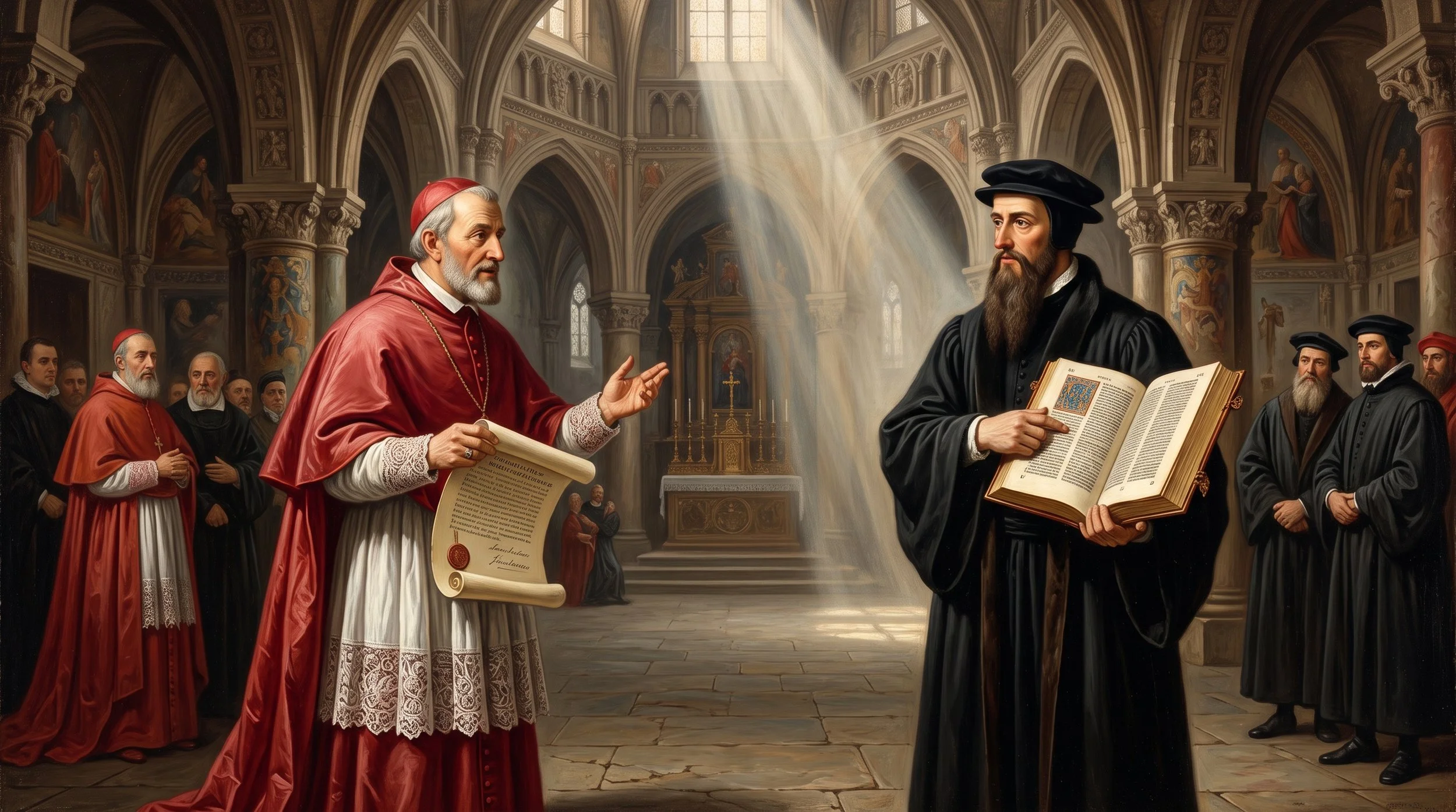
Geneva had only recently accepted the Protestant Reformation, but the cause of reform stemmed more from political expediency than from genuine religious change. When Calvin left Geneva after eighteen months, Cardinal Jacopo Sadoleto, a peace-making, scholarly man who wanted to see the Roman Catholic Church cleaned up in faith and morals, wasted no time trying to convince Geneva to return to the mother church.
Sadoleto wrote a passionate, heart-wrenching letter to the leaders in Geneva, pleading with them that he had “heard the groans of the Church our mother, weeping and lamenting at being deprived at once of so many and so dear children … I was concerned at your losses and dangers.”[3] He particularly appealed to the unity of the church, begging them to “return to concord with us, yield faithful homage to the Church, our mother, and worship God with us in one spirit.”[4]
Calvin responded to Sadoleto, assuring him that he, too, was eager for unity. However, for Calvin, unity for its own sake was dangerous, and must be founded on truth, particularly as found in the Scriptures. He argued that the Holy Spirit, whom Sadoleto invoked for unity, was always joined to the Word of God, and that the Church cannot be governed without both:
“For seeing how dangerous it would be to boast of the Spirit without the Word, He declared that the Church is indeed governed by the Holy Spirit, but in order that that government might not be vague and unstable, He annexed it to the Word.”[5]
So, what was at the heart of this unity, or lack of it? Calvin identified it clearly:
“You, in the first place, touch upon justification by faith, the first and keenest subject of controversy between us. Is this a knotty and useless question?”[6]
Calvin and other Protestant reformers had been accused “that by attributing everything to faith, we leave no room for works.”[7] Calvin would have none of that argument. He laid it out for Sadoleto:
“When we embrace Christ by faith, and come, as it were, into communion with Him, this we term, after the manner of Scripture, the righteousness of faith. What have you here, Sadoleto, to bite or carp at? Is it that we leave no room for works? Assuredly we do deny that in justifying a man they are worth one single straw.”[8]
Calvin continued by offering a thoroughly Trinitarian argument for the necessity of good works for a follower of Christ. Good works were not “worth one single straw” for justification, but they were not eliminated:
“For if he who has obtained justification possesses Christ, and at the same time, Christ never is where His Spirit is not, it is obvious that gratuitous righteousness is necessarily connected with regeneration.”[9]
In other words, a person cannot receive forgiveness, or justification, without receiving Christ. Where Christ is, so is the Holy Spirit, and an essential role of the Holy Spirit is to bring about regeneration—a new life that honours Christ—in the person who has received forgiveness.
Calvin used the doctrine of the Trinity to assure Sadoleto, and by extension the Genevans, that while good works are not necessary for salvation, there is no possible way a forgiven person would not begin to orient their life toward God and his will for their lives, which included a life lived in obedience to him, for his glory. On the back of this punchy—yet deeply respectful—response to Sadoleto, the Genevans begged Calvin to return, and he did, staying until his death.
Justification was no knotty, useless question then or now, and any unity without addressing these fundamental issues is paper-thin at best, ready to fracture with the smallest pressure.
[1] Pope Francis on Twitter (as it was called at the time), 19 January 2017.
[2] See, for example, the lengthy Decree on Justification from Session XI of the Council of Trent on 13 January 1547 and the Joint Declaration on the Doctrine of Justification (1999), both of which acknowledge the doctrine of justification as central to the divide between Protestants and Catholics in the sixteenth-century Reformation. The issue spanned Europe; for example, Martin Bucer wrote to Thomas Cranmer on 29 October 1539, “Lord grant in the meantime, that you may faithfully retain and rightly explain that chief head of Christian doctrine, namely, the article of justification.” Martin Bucer to Archbishop Cranmer, 29 October 1539. See Original Letters Relative to the English Reformation, 1537–1558. 2 vols. (ed. H. Robinson: Cambridge: Cambridge University Press, 1846–1847), 2:529.
[3] John Calvin and Jacopo Sadoleto, A Reformation Debate: Sadoleto’s Letter to the Genevans and Calvin’s Reply: With an Appendix on the Justification Controversy (ed. John C. Olin: New York: Harper and Row, 2000), 25.
[4] Sadoleto’s Letter to the Genevans and Calvin’s Reply, 41–42.
[5] Sadoleto’s Letter to the Genevans and Calvin’s Reply, 54.
[6] Sadoleto’s Letter to the Genevans and Calvin’s Reply, 60.
[7] Sadoleto’s Letter to the Genevans and Calvin’s Reply, 60.
[8] Sadoleto’s Letter to the Genevans and Calvin’s Reply, 61.
[9] Sadoleto’s Letter to the Genevans and Calvin’s Reply, 62.
Rachel Ciano is a Reformanda Initiative Fellow and Lecturer in Christianity in History at Sydney Missionary and Bible College. Her research and publications are wide-ranging with a particular focus on the 16th Century Reformation period. She is married to Ross and they have two sons.