
The Essential Issue: Luther's Bondage of the Will and Roman Catholic Soteriology
This article is a shortened version of the longer paper I presented at the 2026 Rome Scholars and Leaders Network. I used Claude AI to condense the paper into this article.
On 10 December 1520, students and faculty gathered outside Wittenberg's city gate around a bonfire. Into the flames went volumes of canon law and scholastic theology, and finally the papal bull Exsurge Domine, which Luther himself lowered in, "trembling and praying." The bull had condemned forty-one of Luther's propositions and given him sixty days to recant. Of those forty-one articles, one mattered to Luther more than all the rest: Article 36, in which he declared that after the fall, free will exists "in name only," and that fallen man, doing all that lies within him, still sins mortally.
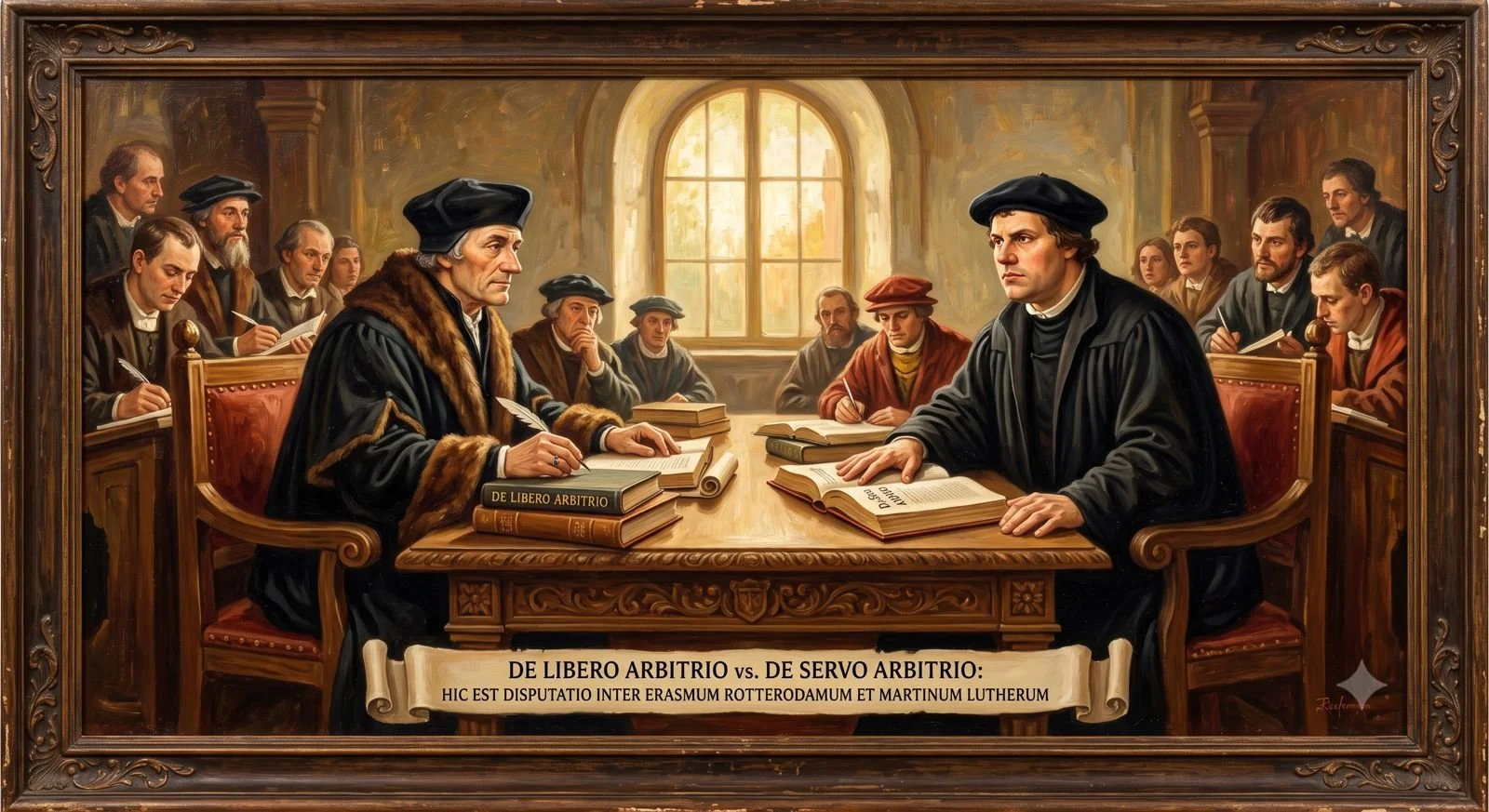
This single article — on the bondage of the human will — became, in Luther's eyes, the central dividing line between his Reformation and the Church of Rome. When the humanist scholar Erasmus finally entered the ring in 1524 with On the Freedom of the Will, he chose this very point to attack. Luther's reply the following year, On the Bondage of the Will, concludes with a compliment: alone among his opponents, Erasmus had identified the real issue, the hinge on which everything turned. Not purgatory, not indulgences, not the papacy — but whether fallen man retains any capacity to choose or contribute toward his own salvation.
Where the Doctrine Came From
Luther's conviction did not appear overnight. He had been trained in the via moderna of Ockham and Biel, which taught a "pactum": if a sinner simply does what is in him, God rewards the effort with grace. This system distinguished "congruent merit" (a fitting reward for unaided human effort) from "condign merit" (a truer merit, possible once grace has been given). As Luther studied Scripture, especially Paul's letter to the Romans, he came to see this whole framework as unbiblical.
By 1516, lecturing on Romans, Luther was already citing Augustine's verdict that the will, apart from grace, is not free but enslaved. The conviction sharpens across his early writings: the 1517 Disputation against Scholastic Theology, where he insists the will is captive rather than free, and the 1518 Heidelberg Disputation, whose thirteenth thesis — that free will after the fall is "a thing in name only" — would reappear almost verbatim as the condemned Article 36. For Luther, sinful humanity remains free in matters "beneath" itself, ordinary human affairs, but utterly without power in matters "above" itself: the things of God and salvation.
Erasmus's Case for a Free Will
Erasmus did not deny grace; he insisted that all is of grace. But he wanted to preserve some role, however small, for human cooperation. He catalogued several positions on the question — from the Pelagian view that humans can reach salvation through unaided effort, through Scotus's version of the pactum, to three increasingly severe positions that left little or nothing to free choice. Erasmus also objected to Luther's taste for dogmatic certainty, arguing that Scripture deliberately conceals some truths and that believers should defer to the judgment of the church fathers rather than press into such mysteries.
Luther's reply was blistering. To delight in firm doctrinal assertions, he wrote, is the mark of a Christian; abandon them and Christianity itself disappears. He devoted much of his book to defending the clarity of Scripture against Erasmus's claim that it is deliberately obscure. He also rejected Erasmus's appeal to a modest compromise: even the smallest contribution attributed to free will, any human cooperation, however minimal, undercuts Christ, because it leaves justification dependent, in the end, on the sinner's own effort.
Crucially, Luther denied that his doctrine of necessity meant compulsion. The unregenerate sin, he argued, not against their will but willingly and readily — the necessity lies in the will's fixed direction, not in coercion. He returns to Augustine's image of the will as a beast of burden: ridden by Satan, it goes where Satan wills; ridden by God, it goes, freely and gladly, where God wills. Conversion does not free the will from being ridden; it changes the rider.
From Erasmus to Rome Today
The Council of Trent (1547) explicitly targeted Luther's language, pronouncing judgment on anyone who taught that free will after Adam's sin was merely a name without a reality. Trent affirmed instead that grace, while necessary, requires the sinner's active cooperation, and that justified believers truly merit eternal life through grace-assisted works. The modern Catechism of the Catholic Church preserves this same balance: sin has wounded human nature without destroying it, and salvation rests on a genuine partnership between God's grace and human freedom.
Some Catholic scholars, notably Harry McSorley, have argued that Luther's basic insight about bondage to sin is itself the authentically Catholic position, and that Luther erred only in his further claims about universal necessity. However, the language of Trent's canons, and the Catechism's repeated talk of human "collaboration" in justification, stands in direct opposition to Luther's central claim, whatever common ground exists on the depth of sin's wound. Reformed voices from Calvin onward have made a similar charge — that Rome's account of sin, however serious-sounding, ultimately treats the will as weakened rather than dead, leaving room for a cooperation the Reformers thought impossible.
Why It Still Matters
If Luther was right that this question — not the papacy, Mary, or indulgences — was the essential issue dividing Rome from the Reformation, then evangelical engagement with Catholics today should follow his example: keep the main thing the main thing. Peripheral controversies are not unimportant, but they are not where the Gospel itself stands or falls. The deeper, more searching question is whether fallen human beings contribute anything at all to their own salvation, because grace, to remain grace, must exclude cooperation entirely (e.g. Romans 11:6). Since many ordinary Catholics may understand their own faith in even more works-based terms than official doctrine allows, conversations about sin and grace — rather than about institutional or devotional practices — may open the most fruitful path to the Gospel.
This has a second edge, turned back on evangelicals themselves. Much contemporary evangelical piety, shaped more by generic decisionism than by the Reformation's own theology, has quietly drifted toward the very cooperative framework Luther spent his career opposing. Recovering a robust doctrine of the bondage of the will, is not an antiquarian exercise but a pastoral and apologetic necessity — pursued, finally, with humility rather than triumphalism. Luther himself insisted that none of this was meant to commend himself, but to extol the grace of God.
Finally, remembering the doctrines of sin and of grace brings a deep comfort to the believer. Luther wrote: “Since God has taken my salvation out of my hands into his, making it depend on his choice and not mine, and has promised to save me, not by my own work or exertion but by his grace and mercy, I am assured and certain both that he is faithful and will not lie to me, and also that he is too great and powerful for any demons or any adversities to be able to break him or to snatch me from him.” [1] May we follow his lead and rejoice in the doctrine of the bondage of the will and in free, unmerited salvation in Christ and may we share this good news with all around us.
[1] Martin Luther, ‘On the Bondage of the Will’, in Luther and Erasmus: Free Will and Salvation, vol. 17, trans. Watson Philip, Library of Christian Classics (SCM, 1969), 328–29.
